Earlier in the year I organised for Professor Matthew Molineux to do an in-service for the Townsville District MH OT’s via Video conference on Occupation Based Practice. Quite a number of OT’s here were taken with the messages he was delivering and at the end he mentioned that he would be more then happy to come up to Townsville if the district could bring him up.
So we set about trying to organise to get him up here. One of the OT’s working in the main part of the hospital (Kym Murphy) put together a funding application to the Private Practice Fund that was approved and flights & accom etc was organised.
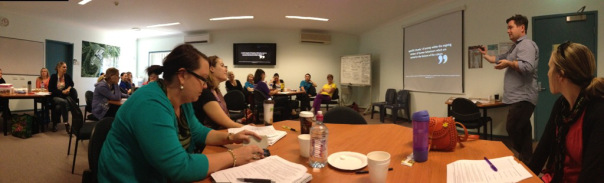
I’ve seen Matthew do short 1hr talks on Occupation and its place in OT a few times and have read a few of his papers (Molineux, M. (2011). Standing firm on shifting sands. New Zealand Journal of Occupational Therapy, 58(1), 21-28. is one of favorite papers ever) So I felt that I had a rough idea of the importance and the the emphasis Matthew puts on OT’s using Occupation in practice and not just as a result of practice. At the beginning of the day I was more excited about seeing other OT’s in my district and how they would react to the messages they were about to get. To see if any of them would have the ‘lightbulb’ moment that I had nearly a year earlier after reading the previously mentioned paper.
Another thing that I was actually really excited about was that this was the first PD I had been to in this district, or any district for that matter where it was all OTs but had OTs working in both mental health and physical areas of practice. That really never happens and I was super keen to see how it would affect the group dynamics.
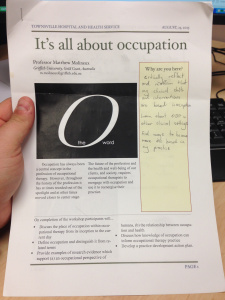 The workshop began with reflective exercise’s and then a laying of the groundwork around the history and development of Occupational Therapy and then into how OTs look at Occupation. Matthew introduced The Nature of Occupation (Molineux, 2010) which is something I spoke about in a previous blog post (Student Occupation Based Practice Workshop). It was really encouraging for me to see how the other OTs in the room took this method of thinking about occupation on board. Now I’m not saying that all in attendance instantly got the concept but even the tiniest advancement is a win in my books!
The workshop then moved on to how Occupation should fit within Occupational Therapy. It cemented home a few truths to me, especially about OTs who get so caught up in ‘function’ they loose the true power of occupational therapy which is ‘Occupation.’ I was presented with some very practical ideas that I am going to use in my thinking and my clinical application.
One was “Occupational Diagnosis” (Rodgers, 2004) which I intend you use in my clinical documentation and MDTR. This tool will allow me to 1) allow me to expose the rest of my clinical comrades to Occupational language in a non-threatening, non-invasive way that they are more likely to take note of. Its a simple, easy to remember, and logical method of describing a person’s occupational situation in any written or oral handover.
Another was a flowchart (seen below) from Hocking’s 2001 paper on Occupation Based Assessment. This clearly shows that although ‘function’ may be important in some circumstances, it is most definitely no the main or initial focus of Occupational Therapists. This is a pet hate for me and one that really frustrates me when OTs only focus on ‘function’ because it’s “what an OT does” or because “its the same as occupation anyway.”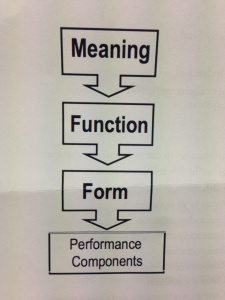
At the end of the workshop the group was to make plans for “where to from here?” There was a definite mood change in that instant where it became very apparent that many people had been accepting of all the information presented (fully understood or otherwise) but didn’t seem confidence enough to commit to change. I put forward a regular meeting open to all the OTs in the district where issues around OBP, success’ and failures, literature and ideas could all be brought and discussed.
I am really hoping that this group will be able to continue the momentum in changing the districts current practice to be more Occupation Based. I’m hoping that through this group we can continue the exposure our OTs get to OBP literature and practice examples. That, Occupation Based Practice and clinical reform to gain back our professional identity will snowball in this district. This isn’t going to be easy, I’m under no illusion of that.
Some of our OTs definitely seemed to struggle with the concept of practicing with “Occupation as a Means and Occupation as an Ends” (Gray, 1998). It did seem that this was mostly due to work structure, expectations and policy constraints. I agree that, yes, there are issues and barriers, but giving in to these barriers and letting them shape us as a profession is how we got to where we are now. We are slowly (some say rapidly) moving further and further away from “Occupation as a means” as we let the medical model and policy makers shape our practice without any resistance or assertive guidance from ourselves as a profession and as an individual.
In the end it starts and ends with us. I’ve made the commitment to myself and to my profession to be as true to the OT core beliefs as I can and will do whatever is in my power in order to do so. I’m hoping that using this workshop as a catalyst I am able to convince others to do the same, who will in turn convince others, and so on and so on until…
…..OTs take over the world….

