All posts by BrockOT

About BrockOT

Founder and facilitator of MH4OT, fb group, twitter and www.mh4ot.com

QLD Mental Health and Paediatric Symposia 2013

Last weekend I attended the 2013 Mental Health & Paediatric Symposia at Seaworld on the Gold Coast.

This was a fantastic event which, (I’ve heard) had a few hiccups behind the scenes but ran seamlessly for attending delegates.

photo3

The symposium format (longer workshops rather then short rapid fire presentations) allowed time for the processing of new ideas and concepts and the discussion of these. I felt like this allowed me to learn a lot more ‘whole concepts’ rather then initial introductions to many different topics.

I was honored to also be invited to speak on the professional use of technology and apps in occupational therapy.


Tina Champagne Keynote: Reclaiming Occupation: A Non Linear Science Approach

DISCLAIMER: This was a VERY complex and heavy concept but I’ll reflect upon my understanding of it. I may be completely wrong but this is my subjective experience.

I’ve been quite keen to hear this keynote for some time. For a long while in my discussions with her Tina has mentioned this “Non-Linear Science” but I’d never understood exactly what she was talking about, so when she told me she was going to give her keynote on the topic I was very keen to soak this in.

I’d be lying if i didn’t get a little satisfaction seeing Tina used one of my Occupational Musings as a slide in her presentation to highlight Matthew Molineux’s “Nature of Occupation”. (Molineux, 2010) photo 1
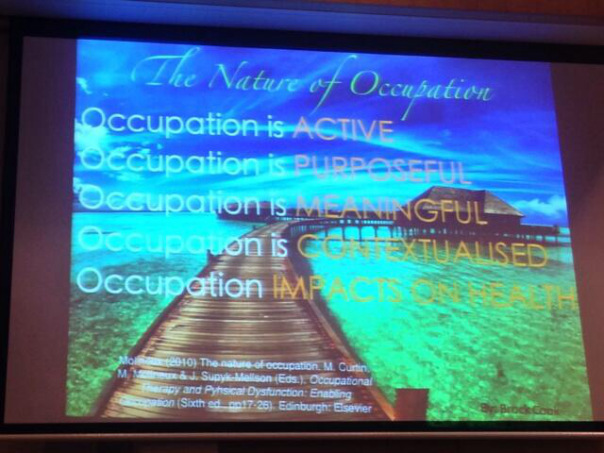
Tina started by explaining that the theories of non-linear science evolved from mathematics and physics and other “sciences” that delt with non-linear dynamic systems. It is also easily recognized that the Human body and life itself is also a non-linear dynamic system. This view of human beings is an interesting one that on the whole seems to sit outside any health specific models. Most of the points made absolute subjective sense to me whilst sitting there. My experiences with life, people, injury, the environment all seemed to fit quite easily within this idea that all things are codependent on each other. There seemed to be something very ‘spiritual’ about this way of thinking. The fact that there was a connection, an influence, a correlation between every “system” and its environment. And the fact that the influence is a two way dynamic. The system influences the environment and the environment influences the system. Now I know that OT’s are reading this and going….”deeeerrrr.” But the point that this brings up is that OT’s are always looking at the evidence behind something (or lack of). Non-linear science takes already well established scientific theories such as Chaos Theory and shows how humans as occupational beings can be explained/fit into this (in this example) well researched astrophysics theory. photo 2
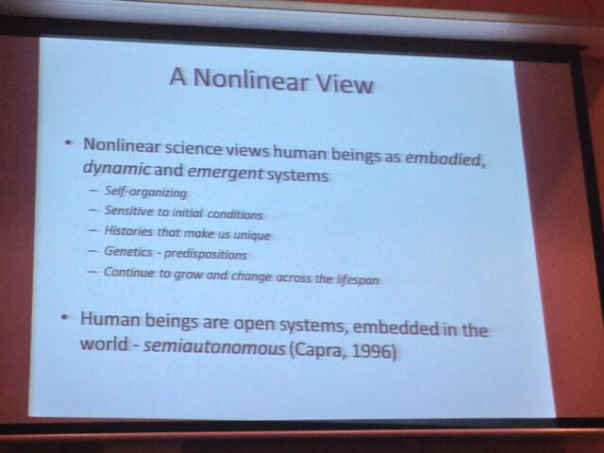
The concept that a human being is a self-organising, non-linear dynamic system may sound very complicated but in essence its something that most of us have always known. Its just being described using a scientific language common across many professions the world over. This idea that what we have been doing for years can already be explained by seemingly unrelated science that was established many many many years prior to our profession even beginning did initially make me skeptical. But everything that was presented made perfect sense to me. It’s an extremely large and complex field of theory but I’ve committed to have a look into it.photo 3
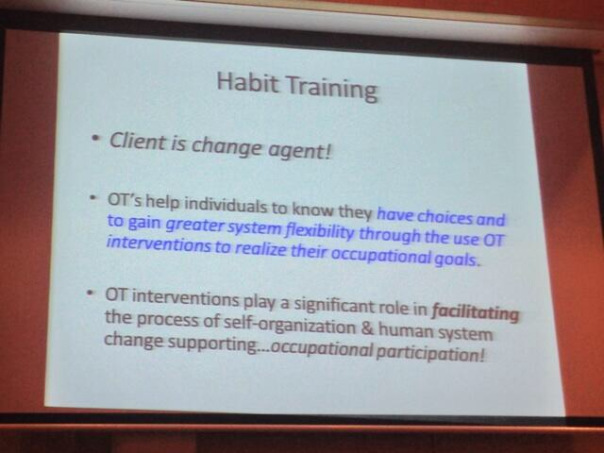
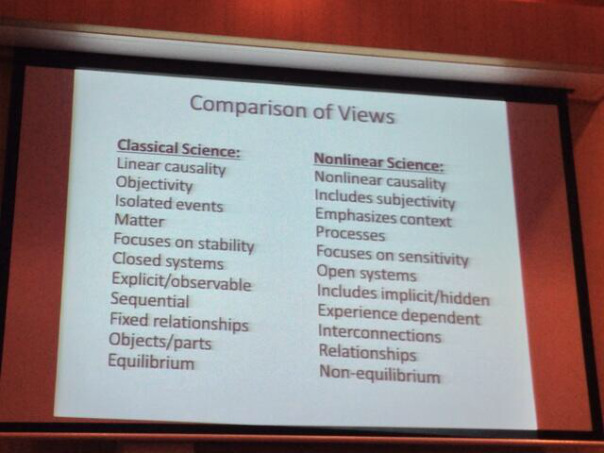
The comparison between a Classical Science and a Nonlinear Science was a really good demonstration of the correlation to how Occupation fits better within it then a traditional science lens.photo 4
Overall it was an extremely interesting perspective on occupation and Occupational Therapy that I had not previously been exposed to. It’s definitely something that I want to read up more on and will be continuing discussions with Tina about this in the future.

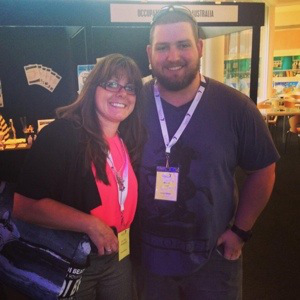
and of course I couldn’t let her get away without a shameless fan pic 20131026-231049.jpg
Embracing New Technologies in Occupational Therapy: from Social Media to Apps

With the social media aspect I took a different approach to previous presentations in that, previously I spent a lot of time looking at what exactly makes up the power of social media and the different types of user categories. This presentation I wanted it to be a little more”hands on”. I still have a very brief talk on the sheer size of some of hue he major social media tools (Facebook & Twitter) to highlight why we use them. Then I went right into examples of professional social media use as well as how these experiences can be utilised towards a clinicians CPD record.


OTA QLD Mental Health and Paediatric Symposia 2013
from Brock Cook
20131026-230840.jpg

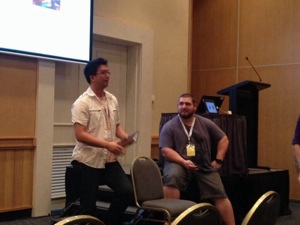
Adam showed some Apps that he had found (can be seen in the embedded presentation) One thing that Adam presented on that really caught my eye was Massive Online Open Courses (MOOC).

It is a free web based platform that allows the user to develop and implement online training courses. It is currently be used by various universities from all around the world. This is something that I believe I may be able to utilize in the future and one that I will be thoroughly exploring!


Occupation Based Practice: It’s time to walk the talk

The first thing I hear from Matthew as I walk into the room is “why are you in here? You’ve heard this a thousand times” This statement along got me thinking, before the workshop had even started. Yes I had heard quite a few talks on Occupation Based Practice, and yes I had seen/heard Matthew give quite a few of those. So what was I there?

I have a firm belief that I’m still in a very novice stage of my knowledge about Occupation Based Practice. Maybe comparatively not but that is where I subjectively rate myself to be sitting at this time. So one reason I was there was because every time I listen to a talk on OBP I absorb something different. A reference. A concept. An Idea. A view. Whatever it is i get a little something different each time which I add to my overall bolus of knowledge. Slowly growing it bigger.

One way that I think this happens is that each of the talks has different participants, working in different settings, in different places. All of these contextual factors mean that different examples, questions and confusions arise in each different talk. These are where I learn to apply some of my acquired knowledge to various contexts to see how i might view the situation if placed in that other persons shoes. I guess I’m grounding my knowledge.

This particular talk caught my eye with the title.

“Occupation Based Practice: It’s time to walk the talk”

This seemed to fit perfectly with where I am at in my professional reform journey. I have quite a lot of the basic theoretical knowledge behind me now. I’m comfortable talking about Occupation and OBP and now am in the process of trialing different methods of operating in my workplace.
20131026-231745.jpg

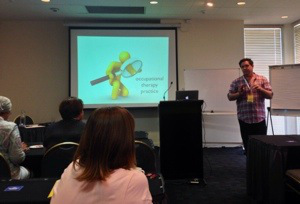
Some interesting concepts came up that I hadn’t thought of before. One was the different categories of practice. Direct Service Provision, Indirect Service Provision and Consultancy. Obviously the ideal situation is to be providing OBP by direct service provision. That is pure beautiful occupational therapy. In my current role however I feel that with the environmental restrictions due to the ward and the Mental Health Act quite often what I do would fit within Indirect Service Provision. I may well sit and do all the groundwork with a consumer but then organise with Community teams or NGO’s to actually assist the consumer in engaging in the occupations they they identified as meaningful to them.

This on its own raised some important questions.

I’m already of the opinion that the AMHU may not be a setting where OT is ideally placed, and looking at it from this point of view kind of validated this feeling in a way. But it also raised more questions.

- Is it ok to fall solely into an indirect service provision role?
- What are the outcome difference between direct and indirect service provision if the consumer is engaging in their occupations with both?
- Should I be fighting the system to include more Direct OBP Service Provision in my workplace?

All these questions have highlighted new gas in my knowledge that I feel an innate need to have answered before I am able to proceed in re-engineering my current role.

Whatever the answers may be, the truth is that there has been enough talk and it’s time to be occupation based.


How to be wanted when your are not wanted: Engaging disengaged consumers

On the second day I attended a Mental health panel discussion about techniques and examples of how to engage with consumers who are disengaged with the service.

The panel of 6 OTs from various MH practice areas each gave an example or two of a time when they were able to engage with a difficult or disengaged client. These “techniques” were then collated in a list on a whiteboard for everyone’s reviewing.

Throughout the 19 or so techniques that ended up being listed I drew two very simple conclusions/techniques.

1) the client needs to be given back the locust of control of the situation. It’s no use in trying to force rapid rapport building on a person as all the most amazing communication techniques in the world won’t make it work if the consumer is feeling pressured and doesn’t want to engage in the first place.

So I suggested to the group that the key is to simply let the consumer have complete control of the process. Make herself and what you offer available and if they want it, they’ll come to you.

2) please don’t lie to your consumers for the purpose of speeding up the rapport building process. This is a sure fire way to kill any rapport you have managed to build in an instant.’

Taking the rapport building process slow and engaging in occupations with the consumer is by far the best and most effective method of engaging disengaged consumers I’ve ever used.20131026-232005.jpg
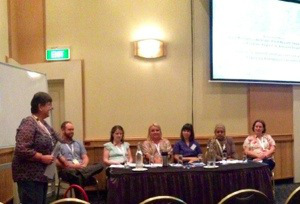
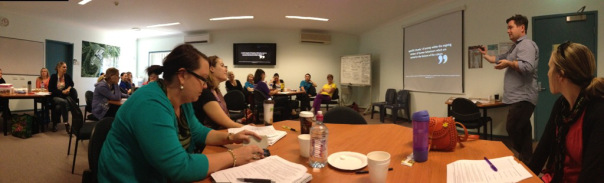
Overall I had a fantastic experience at the OTA QLD Mental Health & Paediatric Symposium, catching up with old friends, making new friends and learning new things. I’ll definitely be looking forward to this type of even again in the future.
OTA2013 Short Oral Abstract: Occupation-focused practice: From enigma to action

Occupation-focused practice: From enigma to action

Brock Cook1, Robert Pereira 0 ,2, Matthew Molineux0 ,3
1Townsville Hospital, Townsville, Queensland, Australia, 2Macquarie University, Sydney, New South Wales, Australia, 3Griffith University, Southport, Queensland, Australia

Introduction

While multidisciplinary team members share some knowledge and skills, it is important to recognise the unique contribution of each profession. A team-based approach to service delivery can lead to effective service provision and quality care. Within multidisciplinary teams, the lack of professional identity can sometimes cause occupational therapists to adopt a range of roles or duties, regardless of their relevance to occupational therapy (Fortune, 2000). In reality, working within multidisciplinary teams can lead to role identity confusion, role overlap, role blurring and role ‘violation’ (Wilding & Whiteford, 2009). One of the mistakes the profession has made is to try to justify the use of any intervention method by arguing that as long as the aim is an occupational outcome then it is occupational therapy (Molineux, 2011).

Objectives

This paper critically interrogates some of the tensions and dilemmas which have impacted on adopting an occupation-focused practice ethos. It does this through a review of the literature and sharing examples from practice. This will lead to an identification of some of the challenges to operationalising an occupational perspective in practice.

Practice Implications

This paper challenges occupational therapists to critically reflect on the extent to which their own practice is grounded in an occupational perspective. In addition, it focuses on dispelling myths and challenging status quo practices by promoting occupation as means and ends in occupation-focused practice. Finally, it provides an emancipatory agenda where occupation is at the core of contemporary and future practice.

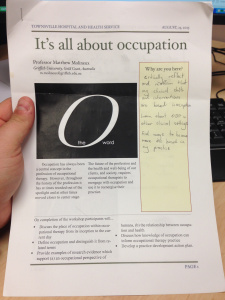
Prof Matthew Molineux: It’s all About Occupation

Earlier in the year I organised for Professor Matthew Molineux to do an in-service for the Townsville District MH OT’s via Video conference on Occupation Based Practice. Quite a number of OT’s here were taken with the messages he was delivering and at the end he mentioned that he would be more then happy to come up to Townsville if the district could bring him up.

So we set about trying to organise to get him up here. One of the OT’s working in the main part of the hospital (Kym Murphy) put together a funding application to the Private Practice Fund that was approved and flights & accom etc was organised.

photo

I’ve seen Matthew do short 1hr talks on Occupation and its place in OT a few times and have read a few of his papers (Molineux, M. (2011). Standing firm on shifting sands. New Zealand Journal of Occupational Therapy, 58(1), 21-28. is one of favorite papers ever) So I felt that I had a rough idea of the importance and the the emphasis Matthew puts on OT’s using Occupation in practice and not just as a result of practice. At the beginning of the day I was more excited about seeing other OT’s in my district and how they would react to the messages they were about to get. To see if any of them would have the ‘lightbulb’ moment that I had nearly a year earlier after reading the previously mentioned paper.

Another thing that I was actually really excited about was that this was the first PD I had been to in this district, or any district for that matter where it was all OTs but had OTs working in both mental health and physical areas of practice. That really never happens and I was super keen to see how it would affect the group dynamics.

photo2The workshop began with reflective exercise’s and then a laying of the groundwork around the history and development of Occupational Therapy and then into how OTs look at Occupation. Matthew introduced The Nature of Occupation (Molineux, 2010) which is something I spoke about in a previous blog post (Student Occupation Based Practice Workshop). It was really encouraging for me to see how the other OTs in the room took this method of thinking about occupation on board. Now I’m not saying that all in attendance instantly got the concept but even the tiniest advancement is a win in my books!

The workshop then moved on to how Occupation should fit within Occupational Therapy. It cemented home a few truths to me, especially about OTs who get so caught up in ‘function’ they loose the true power of occupational therapy which is ‘Occupation.’ I was presented with some very practical ideas that I am going to use in my thinking and my clinical application.

One was “Occupational Diagnosis” (Rodgers, 2004) which I intend you use in my clinical documentation and MDTR. This tool will allow me to 1) allow me to expose the rest of my clinical comrades to Occupational language in a non-threatening, non-invasive way that they are more likely to take note of. Its a simple, easy to remember, and logical method of describing a person’s occupational situation in any written or oral handover.

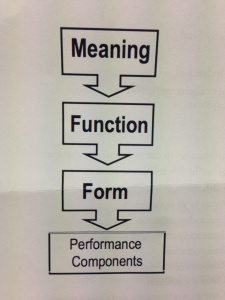
Another was a flowchart (seen below) from Hocking’s 2001 paper on Occupation Based Assessment. This clearly shows that although ‘function’ may be important in some circumstances, it is most definitely no the main or initial focus of Occupational Therapists. This is a pet hate for me and one that really frustrates me when OTs only focus on ‘function’ because it’s “what an OT does” or because “its the same as occupation anyway.”photo3

At the end of the workshop the group was to make plans for “where to from here?” There was a definite mood change in that instant where it became very apparent that many people had been accepting of all the information presented (fully understood or otherwise) but didn’t seem confidence enough to commit to change. I put forward a regular meeting open to all the OTs in the district where issues around OBP, success’ and failures, literature and ideas could all be brought and discussed.

I am really hoping that this group will be able to continue the momentum in changing the districts current practice to be more Occupation Based. I’m hoping that through this group we can continue the exposure our OTs get to OBP literature and practice examples. That, Occupation Based Practice and clinical reform to gain back our professional identity will snowball in this district. This isn’t going to be easy, I’m under no illusion of that.

Some of our OTs definitely seemed to struggle with the concept of practicing with “Occupation as a Means and Occupation as an Ends” (Gray, 1998). It did seem that this was mostly due to work structure, expectations and policy constraints. I agree that, yes, there are issues and barriers, but giving in to these barriers and letting them shape us as a profession is how we got to where we are now. We are slowly (some say rapidly) moving further and further away from “Occupation as a means” as we let the medical model and policy makers shape our practice without any resistance or assertive guidance from ourselves as a profession and as an individual.

In the end it starts and ends with us. I’ve made the commitment to myself and to my profession to be as true to the OT core beliefs as I can and will do whatever is in my power in order to do so. I’m hoping that using this workshop as a catalyst I am able to convince others to do the same, who will in turn convince others, and so on and so on until…

…..OTs take over the world….

Student Occupation Based Practice Workshop

In August Aidan Parsons and myself contributed to a 2 day MH module at our local university by presenting a 3hr Occupation Based Practice Workshop to the 4 year OT students.

Although the group was very quiet to start with it was fantastic to see the change in thinking that occurred during this 3hr time period. At the beginning of the workshop we brainstormed with the group words that they believed defined Occupational Therapy. The usual suspects were all accounted for but it took a long time before any mentioned Occupation.

We ran the workshop starting with laying the groundwork of knowledge about what the literature has to say about what is occupation, how this is used by OT’s etc. We then moved into a reflective activity around their own experiences on placement, times when they used occ based practice, times when they didn’t, how they could change the times that they didn’t to be more occupation based.

The examples that the student came up with were fantastic and I could see them really grasping the concept of Occupation Based Practice through their examples. The one thing that I think helped them the most was “the Nature of Occupation” (Molineux, 2010). Using this framework for looking at occupation really seemed to help the students grasp onto the complexity of occupation and be able to recognise the differences in how different occupations may fit with different people.

We also did an activity where we asked for a volunteer and, as a group, interviewed them with an occupation focus and really trying to use our occupational language. Before we started, Aidan and I, had no idea how this was going to work as we’d never tried it before. We were both pleasantly surprised at how well this played out. The group was able to interview this volunteer and find out about all the things she likes, wants and needs to do in her life. They looked at her occupational balance and any barriers to her engagement in some occupations. At the end of this I highlighted a few things. I made the point (by asking her) that at no time had the volunteer felt uncomfortable, been put on the spot, disclosed anything she didn’t want to etc. The group agreed that they had more then enough information to find a starting point for their occupation based practice. I made a big point of highlighting that at no point had we ever discussed the person’s diagnosis, illness or disability, as I am a firm believer (and I know that some will disagree) that good occupation focused OT’s can do their job without knowing what a persons “diagnosis/label” is. I believe that this is because we work with the person and their occupational needs and not what a clinical category says their deficits are.

Overall I feel that the workshop went very well and that the students seemed to get a lot out of it that I hope they can carry over to their clinical practice.

Social Media in the Contemporary CPD Climate

Here is the poster that myself, Merrolee Penman, Anita Hamilton, Leonora Coolhaas, Trina Phuah & Allison Sullivan developed for OTA2013.

The poster thus far has received some interest from external media which has been lovely. Feel free to have a read of these here:
http://www.cpdme.com/blog?mode=PostView&bmi=1384889
I take this external interest in our work as a testament to the hard work that our team put in. Very proud

OTA2013

So from July 24-26th I was fortunate enough to attend my very first Occupational Therapy National Conference in Adelaide. Not only was I attending this conference but I was also honoured to be asked at last years QLD State conference if I would join the Senior Management Team as the conference Social Media Coordinator. I’m told this was due to the work I had done with MH4OT but I know that it came mainly from a lovely recommendation of Anita Hamilton.

On top of all of this I also had a short oral presentation with Robert Pereira & Matthew Molineux and a large group poster project with Merrolee Penman, Anita Hamilton, Leonora Coolhaas, Trina Phuah & Allison Sullivan. I’ve learned a multitude of things from all of these various projects that all culminated at OTA2013….then add on top of that the things I learned at the conference!

The SMT
So I joined the SMT for OTA2013 in about October 2012. We would meet via teleconference monthly and discuss everything to do with putting together the conference. This was an absolutely eye opening experience for myself, who had never been involved in anything like this, let along to this scale. Even though I didn’t have a lot to do with the budget side of things it was fascinating to me how much it actually costs to put on an event of this magnitude.

My role within the SMT was to use social media to promote OTA2013 and to also provide and encourage a social media presence during the conference. Secondary to this the tact that I took in organizing the OTAust Facebook, twitter and instagram accounts was aimed at raising the overall social media presence of the association and therefor the number of OT’s that they are able to connect with using these tools. To start with I don’t think I was 100% certain what exactly I was doing or how I was meant to run the social media of an association that represents 1000′s of OT’s around the country and the profession as a whole on the international stage. There wasn’t a lot of guidance around this as to date the association hadn’t had anyone who knew how to use these tools well.

So I did what anyone does when crossing unknown ground….i tiptoed. I tried different things, different posts, using images, asking questions, all the while keeping an eye on the view and engagement stats. Eventually, almost naturally evolving, I found my groove. I have a good idea of the sort of posts that are going to have the biggest impact with the OTAust followers.

This experience has opened doors to many many new opportunities, both nationally and within my state, which I won’t go into right now but I’m extremely excited about what the future holds.

The Presentations
For OTA2013 I had two different abstracts accepted with 2 different groups of people. Both of these groups connected virtually, and both operated very differently.

The first was “Social Media in the contemporary CPD climate: why it is easier than you think to take advantage of these valuable learning opportunities” and was accepted as a poster. I was nominated as the lead author/coordinator for this project.

We were all heavily involved in social media on different platforms and using it as a CPD tool. With the introduction of National Registration last year OT’s in Australia now have a structured CPD requirement that must be recorded and can be audited for the purpose of continued registration to practice. We wanted to show conference delegates how they could tap into this relatively new resource, quickly & easily and how they could utilise them for their own CPD points.

We had the idea right off the bat to do something that was a little different to any posters any of us had ever seen before and that was to use QR codes to link to external content that delegates could look at and take home on their mobiles/tablets all while standing in front of our poster.

I think the beauty of this project was that the tools that we were demonstrated were the exact tools we used to actually work together to piece it all together from our various locations around Australia and across the world. We showed how Evernote could be used to record a CPD record. How Facebook, Twitter, TED, and Linkedin all contain valuable content that can be utilised for CPD. How WordPress could be used to not only keep a log of your CPD if you wanted to but also provide a place where you could record your reflections on the different CPD opportunities previously mentioned, and then link those blog posts into your CPD record (Evernote). And we also demonstrated how Learnist can be used as a tool for Digital Curation of all of the above resources into one place.

The second was “Occupation-focused practice: From enigma to action” which was accepted as a short oral presentation.

There were three of us who were involved in this presentation. We had met over social media quite a while beforehand and had talked often and discussed the state of OT and occupation, so when the call for papers was sent out we decided to put something together.

This project was much easier and quicker to put together then the Poster but equally as enjoyable. This was partly because the short oral was only 5min long with a couple minutes for questions and partly due to the fact that there were less of us involved then there was with the poster.

The paper was fantastic as it fit right into the personal reading and learning I was doing at the time. Looking at the devolution of the OT role into a “gap filler role” and how I might be able to changed that in my own clinical practice. On top of that having more discussions with two of the OT’s i respect the most in the world was a fantastic experience. The work we did also helped me to gain a much greater understanding of the history and development of Occupational Therapy and how we have moved through different paradigms.

Unfortunately Matthew wasn’t able to make it to Adelaide for the conference so Robert and I presented on behalf of the group. We presented in a fairly informal manor and got some good questions and feedback afterwards.

The Conference
So the conference as a whole exceeded everything I was expecting it to be. I had been talking about it for months with the SMT and thought I knew every little detail but the atmosphere of being around 750 other keen, motivated, enthusiastic OT’s just cant be matched!

I met some amazing OT’s who I’ve read about, heard about, talked to online, seen their work in journals and quoted in my own work. I do love to network so OTA2013 felt like a goldmine for the senses. With my Social Media duties during the conference i felt like i was on my feel, flat out from sun-up to sundown, but i wouldn’t trade it for the world.

After the first day i did find myself in a state of sensory overload. So for the next couple days I did make sure i made the time to take time out from the noise and hustle and do some of my social media work in a quieter area of the conference, e.g. in the exhibition hall while everyone was out watching the sessions. This allowed me to not only get done what i needed to do more efficiently but also to regulate any overload I might feel. As it was the day after the conference i spent mostly in bed absolutely exhausted so can only imagine how I’d be if i hadn’t taken some time out during the days.

Overall the OTA National Conference was an amazing experience to be part of and one that I hope I can be part of for years and years to come.