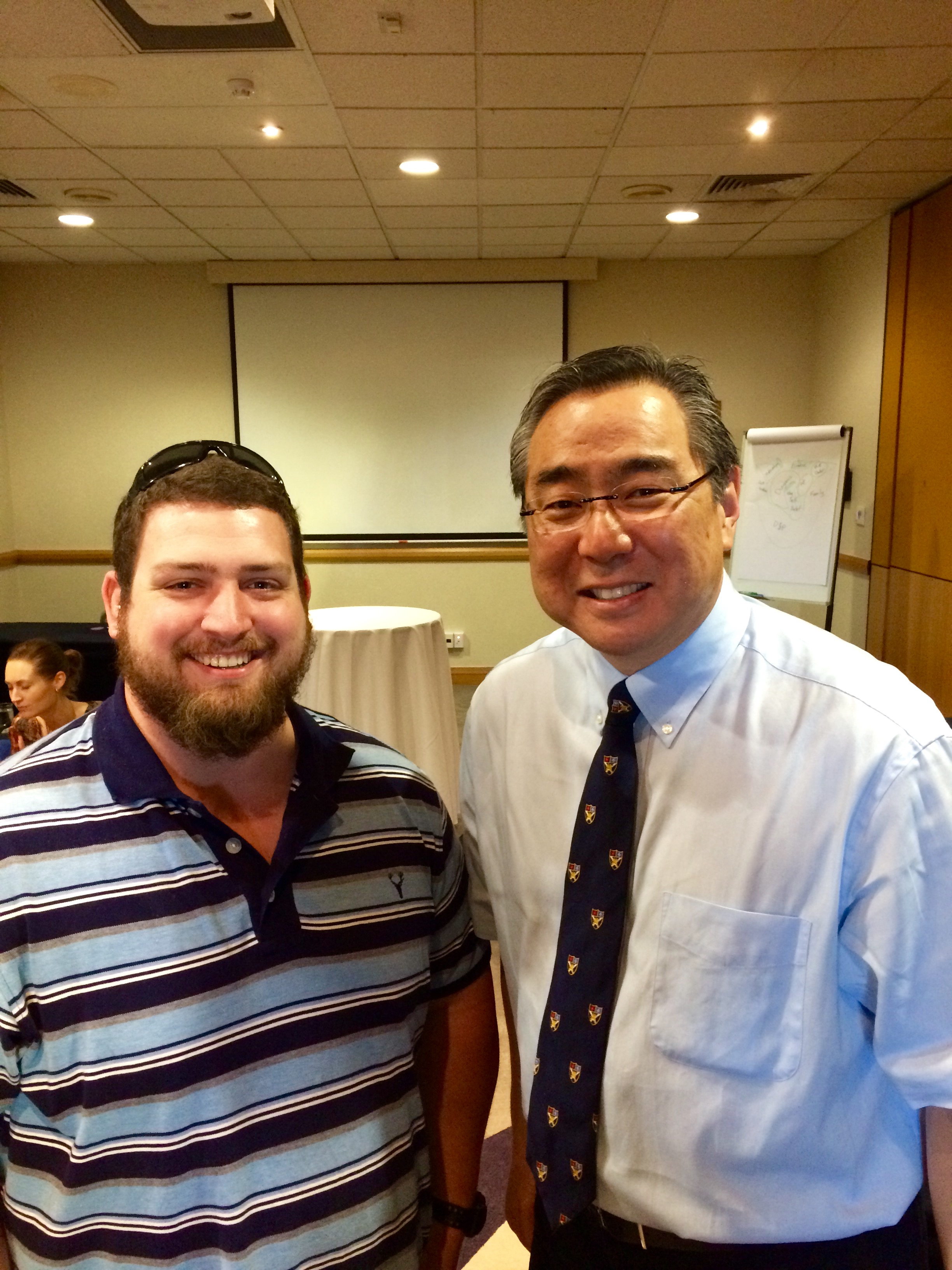
On the 23rd I had the pleasure of attending the “Comprehensive Guide to Applying the Kawa (River) Model in Clinical and Educational Practice Contexts” workshop. If I’m honest, main purpose for attending was to connect with my friend and huge influence on my career, Michael Iwama. I had hoped to have some deep intellectual discussions that would allow me to clarify some of my thoughts and ideas as well as pick up a few new ones to mull over. I got all of this and much, much more.
The day started, as many seem to with a couple selfies of the crowd. lol
Michael started from the very beginning with what was essentially the history of the Kawa model and why he had found a need to develop such a model. Many of the underlying concepts where ones that I had basic knowledge of before based on previous conversations I’ve had with Michael, but his diagrams and method of explaining it reinforced and clarified a lot of these ideas.
He proposed how different people develop different “lenses” which impacts how different people can view the same situation in VERY different ways. It was discussed that a persons various ‘spheres of shared experience’ shape and develop a person into who they are. This fits perfectly with my current understanding of values and how they are developed within people. I’ve found the visual of “spheres of shared experiences” to be an excellent way of consolidating this process in my mind. 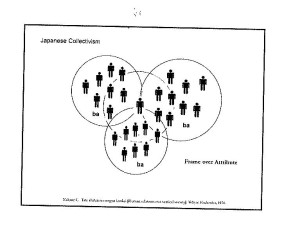 My current knowledge around social constructionism and even my current interest in neuroplasticity all fit very well into this view of the world being shaped by “shared experiences.” I recently listened to an audiobook by Daniel Siegel called The Neurobiology of ‘We’ which went into this idea in great detail making the links between human relationships and, neurobiologically, how this shapes and “wires” our brains. It talks about these neuron firing patterns being, on a cellular level, the lenses we use to view the world. It also highlights strongly the point that due to the concept of neuroplasticity these firing patterns are able to be changed/rewired using collective experiences.
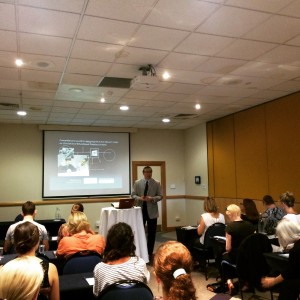 Michael acknowledged his own cultural lens and gave an insight into his narrative and the gradual development of his ideas and thoughts over time based on his many and varied experiences living and working in multiple countries. He used his experiences in Japan and in the USA & Canada to highlight some major disparities between these different cultures, mainly how they view the concept of ‘Occupation’.
The eye opening realisation for me was the different cultural views of the world. This is something that I never would have previously known, not having been immersed in another culture for an extended period of time. The basic premise was that a western view of the world was very modular and de-constructive, pulling large concepts apart into smaller categories in order to make sense of it all. It was stated that OT theories and models developed in the western world looked at the Person, and Environment as separate entities. It is viewed that “Occupation” as we understand it is the persons ability to influence, interact with and manipulate the environment.
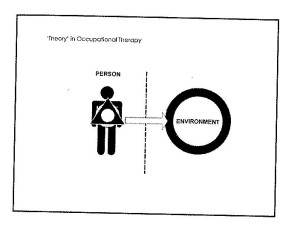 Michael went on to highlight that many cultures do not view the world with this categorised separation and instead view all of these elements as an “inseparable whole”. This vastly different concept of the world leads to massively different values and priorities among people. It shows that in, e.g., east asian cultures the view of the world is of all the various components being a whole. An ecology that is all connected and influential on every other part. This engagement within the whole does not involve a hierarchical measure of each sections value that places people at the ‘top of the food chain’ but rather of a cohabitative equilibrium between people, animals, the world, spirituality etc etc
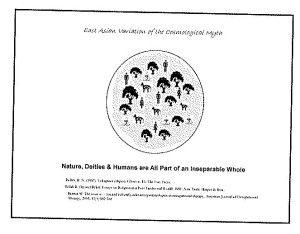 This alternate view of life was initially hard to understand for me being that I have not had the ‘sphere of shared experience’ that would have instilled these values and this view within me. But I was able to begin to relate much of this to experiences that I have had/observed working with people from other cultural backgrounds.
After lunch the group looked at the Kawa model itself and how it was developed to be a client constructed model. This means that as the model is constructed by the client, within their individual context that it bypasses many of the issues observed when a pre-existing model is overlayed over a clients narrative. We worked as groups and discussed various aspects of an example Kawa we each made and I was allowed to present mine to the group for discussion.
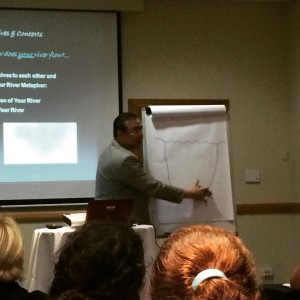
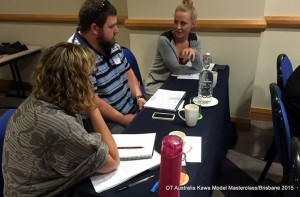
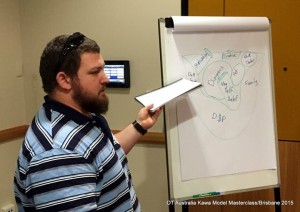
One of the major things I discovered not only during the workshop but in discussions with some of the OT’s afterwards was that the Kawa is not constrained to the river. In fact the concept of the kawa was originally just the four identified areas of “Environmental Factors,” “life Circumstances and Problems,” Personal Assets & Liabilities,” & “Life Flow and Health,” all interconnected and joined to eachother. The river metaphor was implemented to help people to understand the concept of the model but does not have to be the only way.
There was an example given by one of the attendees where they had conceptualised the Kawa using the metaphor of a football game where the persons team represented their personal attributes (driftwood), the opposing team represented discrete circumstances/barriers (Rocks) and the field itself represented the environment (river banks). The aim of the game would then be to have an open flowing game of football with as little opposition as possible so your team could go for the win! In the clients context the game of football was something that was extremely relatable and understandable. This struck me as taking the kawa model to a whole other level when it comes to client constructed models. Lightbulb moment.
This then got me thinking about the diversity I see in the people I work with and how this kawa concept that seems so simple could be utilised as such an amazing, powerful and completely contextualised narrative explanation tool.
This now brings me to think of the Kawa not as a model but as a powerful tool. The reason is that I no longer see the river as fundamental to the success of the use of the kawa but simply as an example of the possible use of the constructs within it. Granted, the river metaphor is still probably going to be the most accessible metaphor to most people to understand (who doesn’t know what a river is?) but I no longer see its as being constrained to this single form.
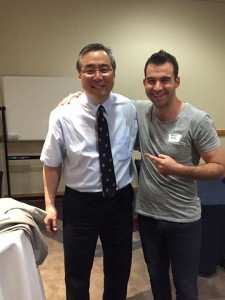
This is my mate Robbie getting his fan picture with (Rockstar) Michael 😛
The conversations continued well after the workshop was finished with a group of us all going for dinner and continuing the amazing learning and discussion that had been prompted and triggered during the day. Lovely spot (ironically) with the Brisbane River in the background. It was lovely to find a person so inspiring and knowledgeable to so many people but still be approachable and able to have a joke with.
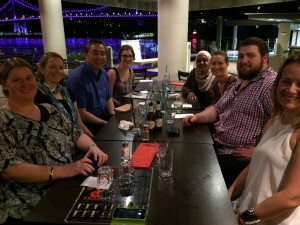
Couldn’t leave without my very own fan pic 🙂
…then it was a short flight back to Townsville to begin consolidating my new found knowledge and looking for practical implications. There were many new ideas and projects birthed from this workshop and I’m blessed to have had the opportunity to turn another one of my online OT connections into a real life friend.
A video put together by Michael as a memento of his Australian trip:
For more information on Kawa please do check out the website: www.kawamodel.com and check out the Kawa app on your iOS device: Kawa iOS App
You really had a light bulb moment, having attended this workshop about 8 years ago it’s great to hear that Michael is as inspiring as ever!!!
This is such an inspiring and awesome take on the Kawa Model. I am a therapist from Mumbai, India and I have used the Kawa with my service users and indeed it’s a client centred and client built approach! In India the medical model is still predominant which makes my use of the Kawa extremely rewarding and personally motivating.
Thank you for sharing this!